Sunday, November 24, 2019

Ligeti, Atmosphères
Wagner, Prelude to Lohengrin Act 1
Berg, Violin Concerto
Brahms, Symphony No. 3 in F major

Vienna Philharmonic
Christoph von Dohnányi, conductor
Rainer Honeck, violin

Musikverein, Vienna (23 November, 2019)


Some problems can be solved with money. Some require time. Getting tickets to a subscription concert at the Musikverein requires both (unless you are prepared to stand, in which case it is pretty easy to pick up a 5 euro ticket). I can't reveal my strategy, of course, but it was certainly worth it to hear the 90-year old Christoph von Dohanyi with the Vienna Philharmonic, which he has conducted many times as a guest conductor.

The program opened with the shimmering sound-world of Ligeti's Atmosphères, a good vehicle to display the orchestra's virtuosity and the conductor's grasp of the progession of blocks of sound. As is occasionally done Dohnányi went straight from Atmosphères to the Lohengrin prelude. This worked very well. The juxtasposition reminding us both of how Wagner was pushing the limits of tonality and of how in this piece Ligeti looks back to a very very late Romantic emotional universe. Berg's Violin Concerto also looks back in the same direction. Dohnányi and Painer Honeck highlighted the diatonic lyricism of the piece, where they obviously had a great rapport.

After the interval, Rainer Honeck returned to his regular position as concertmaster for a deeply satisfying performance of Brahm's Third Symphony, as good as any I have heard. Dohhányi is one of the last great conductors of the post-war era (he took up his first position at Lübeck in 1957), and it was wonderful to hear him working with an orchestra as steeped in Brahms as the Vienna Philharmonic. Brahms's Third Symphony is not easy to carry off well, but it would have been hard to fault this performance, which was justly well received.


Sunday, August 12, 2018

Historical performances from SWR Classic (Sanderling and Hindemith conduct Bruckner and Rachmaninov)


Bruckner, Anton                      Symphony No. 7
Radio-Sinfonieorchester Stuttgart des SWR
Kurt Sanderling
SWR Classic 19410CD

Bruckner, Anton                      Symphony No. 7
Radio-Sinfonieorchester Stuttgart des SWR
Paul Hindemith
SWR Classic 19417CD


Rachmaninov, Sergei              Symphony No. 3
Mussorgsky                             Prelude to Act 1, Kovanshchina
Radio-Sinfonie0rchester Stuttgart des SWR
Kurt Sanderling
SWR Classic 19050CD


SWR Classic is the in-house label for the SWR (Südwestrundfunk = Southwest German Broadcasting Company), issuing recordings from three principal orchestras –Baden-Baden and Freiburg (combined), Saarbrücken and Kaiserlautern (combined), and Stuttgart. Among SWR’s many releases comes a very welcome set of historical recordings from the Radio-Sinfonieorchester Stuttgart des SWR, including these three recordings, which have been digitally remastered from original tapes in the SWR archives.

The Stuttgart orchestra has a very distinguished history. Founded In 1945 by the occupying Allied forces, it has had some celebrated principal conductors, including Sergiu Celibidache, Neville Marriner, and Roger Norrington. It also hosted a veritable panoply of visiting conductors, including the two represented here, Kurt Sanderling and Paul Hindemith.

This performance of the Third Symphony was recorded in March 1995, when Sanderling was in his 80’s. Sanderling spent much of his early career in Russia, after leaving Nazi Germany in 1936. He had a particular affinity for Russian music in general, and in particular the music of Rachmaninov, whose symphonies he thought to be sadly underrated. The Third is a powerful symphony, highly expressive but with subtle orchestration. Sanderling gives a fine performance. The disc also offers a welcome bonus of the Prelude to Mussorsky’s unfinished opera Kovanshchina, evoking the Moscow river at dawn.

Sanderling’s Romantic style is very much to the fore in his December 1999 performance of Bruckner’s Seventh, which he performs in the Nowak edition. His approach is expansive, taking 71 minutes for the symphony (longer than the majority of performances listed in John Berky’s Bruckner discography) and 25 minutes for the Adagio, which is particularly successful. But he is in no way self-indulgent (in the manner of Celibidache, for example, who somehow manages to get 86 minutes out of the Berlin Philharmonic). Sanderling comes across as a conductor of great discipline, although definitely an old school Bruckner conductor.

Paul Hindemith is certainly better known as a composer than as a conductor (he was also a leading viola virtuoso), but he led (and recorded with) many of the leading orchestras of his time, particularly after WWII, when he began to wind down his viola-playing career. This recording of Bruckner’s Seventh dates from June 1958,five years before his death in 1963. As might be expected from a composer famous for his neo-classicism, his approach is much more restrained than Sanderling’s. His performance (of the Gutman edition, which is fairly similar to the Nowak edition) lasts only 59 minutes, with the Adagio a full seven minutes shorter than Sanderling. But it is compelling. The composer of the Matthis der Maler symphony was himself a devotee of counterpoint and clearly is at home in Bruckner’s harmonic language and musical architecture.

The sound quality on all three discs is excellent, even on the Hindemith recording from 60 years ago. I look forward to more fine performances from the SWR backlist.


Thielemann's Bruckner 1 and 3 on Blu-ray


Anton Bruckner, Symphony No. 1
Staatskapelle Dresden
Christian Thielemann
C Major 744704          (Blu-ray)

Anton Bruckner, Symphony No. 3
Staatskapelle Dresden
Christian Thielemann

C Major 740904          (Blu-ray)


With these two performances, Christian Thielemann’s consistently fine Bruckner cycle with the Staatskapelle Dresden approaches its end. There is only No. 2 left to go. It is a little unusual to end a Bruckner cycle with the early symphonies, but here it works well. Thielemann gives powerful performances that highlight continuities with the later, more developed symphonies.

The recording of Symphony No. 1, from a performance at the Philharmonie Munich on September 6, 2017, is actually the first recording of the 1968 Linz version, as edited by Thomas Röder in 2016. This is a lightly revised version of Bruckner’s original 1866 score, prepared for the symphony’s first public performance, and so it offers a chance to hear the symphony as it was heard by a doubtless bemused audience in Linz on May 5, 1868 – the first public performance of any of Bruckner’s symphonies. (The original 1866 score, prepared by William Carragan, has been recorded by Georg Tintner and Gerd Schaller, and differs only slightly from this version.)

The First may be the least known of Bruckner’s symphonies, but it is certainly not a piece of juvenilia (quite apart from the fact that Bruckner was 42 when he composed it). Bruckner’s harmonic innovation is on full display. There are sustained dissonances, particularly in the Finale, and some of what subsequently became Bruckner’s characteristic devices, such as sudden stop in mid-movement. Thielemann and the Staatskapelle bring out the weightiness of the piece (while doing justice to the fine part-writing, particularly for wind). 

The Symphony No. 3 is played here in the 1877 version (Nowak edition). Thielemann makes a strong case for this symphony, which has often been maligned (most famously by Robert Simpson). It is more rough-hewn than the later masterpieces, but in the right hands that can be translated into dynamism and energy. This is perhaps the first of Bruckner’s truly heroic symphonies and this performance does not hold back, coming to a triumphant conclusion in the coda of the finale that is met with rapturous applause by the audience in the Philharmonie Munich.

As with all the discs so far in this Bruckner cycle, the production values are first-rate. The two videographers (Andreas Morell for No. 1 and Elisabeth Malzer for No. 3) use the cameras to good effect to shed light on Bruckner’s orchestration (although I wish they would pan out a little less). The sound quality is excellent – I listened in PCM stereo, but DTS-HD 5.0 surround sound is also an option. My only minor quibble is with the liner notes, which are rather sketchy (the notes for No. 1 do not distinguish between the “real” Linz version recorded here and the subsequent 1877 revision more often described as the Linz version, despite being prepared in Vienna). But this is a minor blemish on two discs that live up to the high standards of this impressive Bruckner cycle.


Thursday, April 12, 2018

Jorge Bolet RIAS recordings Vol. 1 (Audite)


JORGE BOLET, THE RIAS RECORDINGS VOL. 1 (1962-1973)

Franz Liszt
Années de pèlerinage, 1ère année "Suisse", S. 160 (e1 – VI)
Études d'exécution transcendante, S. 139 (1, 2, 8, 9, 11, 12)
Études d'exécution transcendante, S. 139, Nocturnes 1-3
Rhapsodie espagnole, S254/R90, ‘Folies d’Espagne’
 
Moritz Moszkowski
En automne, Op. 36/4

Camille Saint-Saens
Le Cygne (The Swan)

Robert Schumann
Liebeslied (Widmung Op. 25/1), arr. Liszt

Leopold Godowsky
Le Salon
Symphonic metamorphosis on themes from Johann Strauss


Frederic Chopin
Fantasy in F Minor, Op. 49
Impromptu No. 1 in A-Flat Major, Op. 29
Impromptu No. 2 in F-Sharp Major, Op. 36
Impromptu No. 3 in G-Flat Major, Op. 51
Fantasy-Impromptu in C-Sharp Minor, Op. 66
12 Etudes, Op. 10: No. 5 in G-Flat

Claude Debussy
Préludes. Premier Livre (I, IX, X, XII)
Préludes. Deuxième Livre (VI, VCII, VIII, XII)

Jorge Bolet, piano

AUDITE 21.438 (3 CDS)


The Cuban-born pianist Jorge Bolet was a famously late-blossomer, at least as far as fame and fortune are concerned. He sprang into the limelight  at the age of 60, after a celebrated recital at Carnegie Hall in 1974, a mere 37 years after his first recital in 1937. In 1978 he was signed to an exclusive contract by Decca, the source of most of the studio recordings we have of his playing. The performances on this fine 3-disc set from Audite all pre-date his rise. They are taken from original tapes in the archives of RIAS (the Rundfunk im amerikanischen Sektor, which was a radio and television station broadcasting in the American sector of Berlin during the Cold War).

As is usual with releases from Audite, the general production values are first rate. The nicely produced box includes a long essay by Wolfgang Rathert and full recording details. The sound quality is also very good, and certainly good enough to appeal beyond historical recording enthusiasts. 

As a pianist, Bolet elicited strong reactions. Hailed as the last great Romantic pianist by some, he was derided as an empty virtuouso by others. It’s certainly true that he gravitated towards the virtuoso end of the repertoire. This collection contains, for example, one of the Godowsky transcriptions of Chopin’s Etudes, famed for their difficulty. And the second disc ends with a suitably pyrotechnic rendition of Debussy’s ‘Feux d’artifice‘.

The first disc, though, clearly gives the lie to the idea that Bolet had nothing to contribute but his prodigious technique. The six pieces from Liszt’s Années de Pélerinage are played with an emotional range often missing in recordings of Liszt’s solo piano works. I am not much of a Liszt enthusiast at the best of times, but Bolet makes a powerful case for the Études d'exécution transcendante in the six pieces that he plays.

On the other hand, I suspect that many will find his approach to Chopin and Debussy too heavy. He is a master of technique and color, but there is not much of the dance in his Chopin or impressionistic shimmering in his Debussy. Of course, for others these would be advantages.

Bolet was a highly distinctive pianist voice and this collection is an important addition to his discography. The pieces on Disc 2 by Moszowski, Saint-Saens, and Godowsky will be a distraction for some, and a delight to others. But the appeal of this collection surely lies in more mainstream regions of the repertoire. This is a must-buy for Lisztians and deserves serious attention from Chopin and Debussy enthusiasts.


Tuesday, April 3, 2018

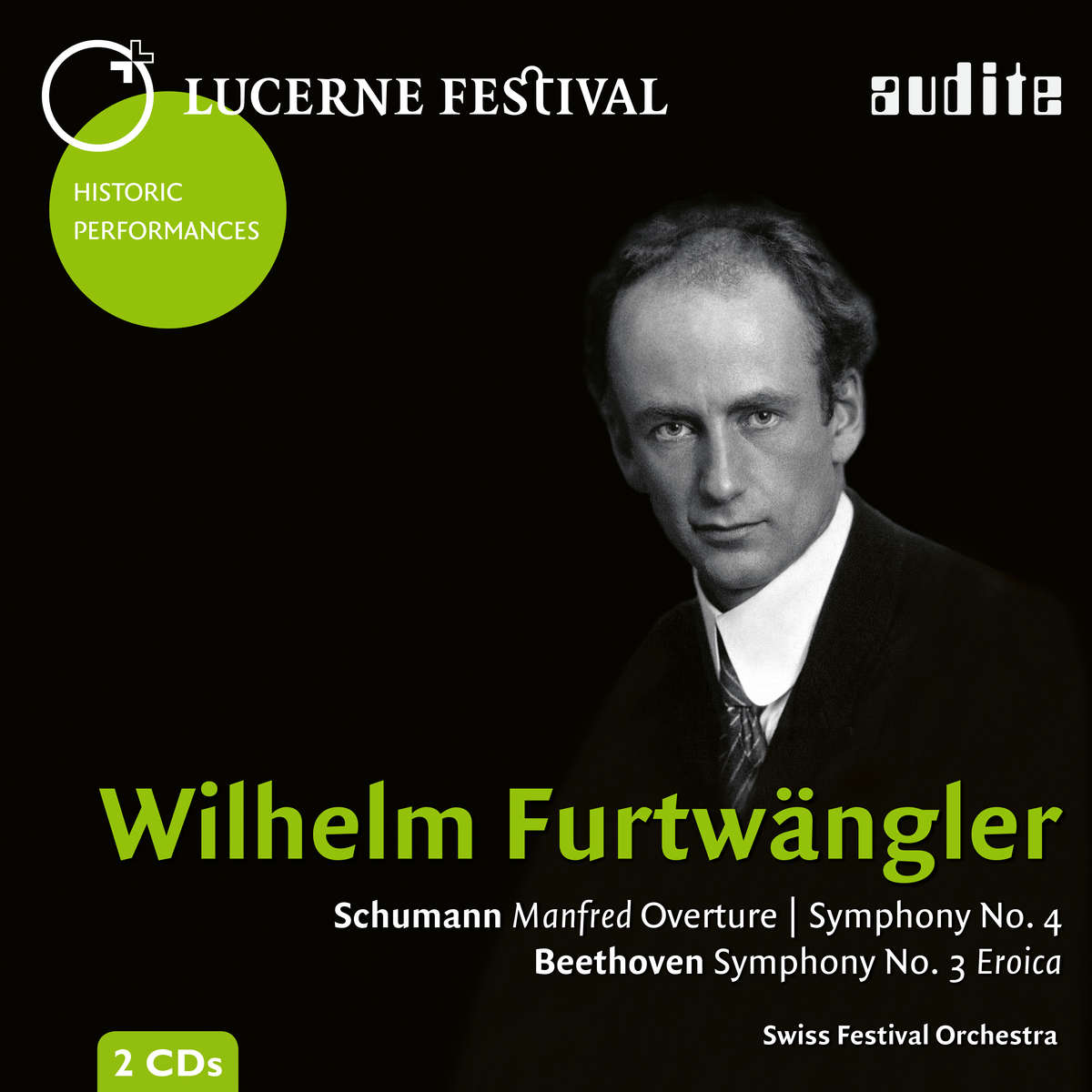
Audite's 1953 Furtwängler Lucerne Festival recordings


Schumann, Manfred Overture
Schumann, Symphony No. 4
Beethoven, Symphony No. 3, ‘Eroica’

Lucerne Festival Orchestra
Conducted by Wilhelm Furtwängler

Audite 91.441 (2 SACDs)


This 2-disc release from Audite of a live performance from the 1953 Lucerne festival is obviously a real treat for Furtwängler fans. But it is not just of historical interest. The sound quality is good enough that it should appeal to anyone interested in outstanding performances of two great symphonies, as well as of Schumann’s Manfred Overture (here released for the first time).

The Schumann and Beethoven symphonies have been issued many different times before, but typically in private recordings made from the radio broadcasts. At best, the sound quality has been acceptable for enthusiasts. This release, however, is based on a remastering of the original tapes rediscovered in the archives of Schweizer Radio und Fernsehen (SRF). The result is extraordinarily good (both when played in a SACD player and on an ordinary CD player). The acoustic clarity of the Eroica recording compares well with Furtwängler’s studio recording for EMI of the same symphony with the Vienna Philharmonic (admittedly recorded nearly a decade earlier in 1944).

All three pieces are played with Furtwängler’s characteristic intensity and depth. The two works by Schumann bring out both poles of the composer’s complex character, as personified in his two personae, the extroverted, boisterous Florestan, and the introverted Eusebio. And it is hard to imagine a better performance of the Eroica, particularly the Funeral March. This is a must-buy disc for anyone seriously interested in the Romantic symphony.

Monday, July 10, 2017

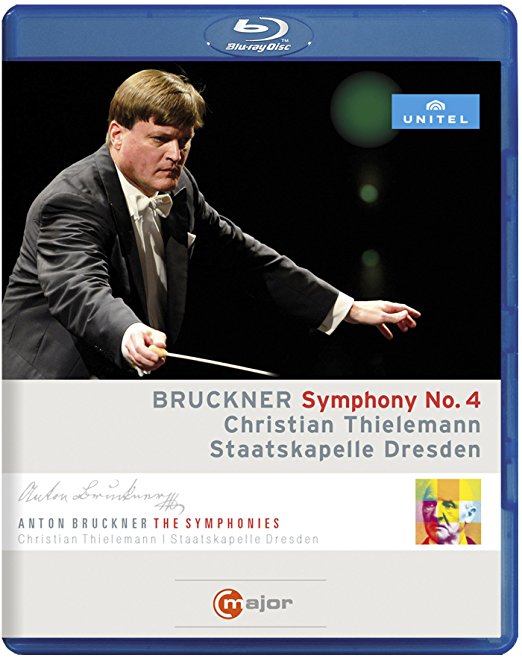
Thielemann's Bruckner 4 and 6 on Blu Ray


Anton Bruckner, Symphony No. 4
Anton Bruckner, Symphony No. 6

Staatskapelle Dresden
Christian Thielemann

C Major 732604        (Blu-Ray)
C Major 738304        (Blu-Ray)


These two Blu Ray discs mark the continuation of Christian Thielemann’s video cycle of the Bruckner symphonies with the Staatskapelle Dresden (I have reviewed the 5th, the 8th, and the 9th - all favorably). Thielemann and the Staatskapelle have stuck with the formula that has worked until now – live performances in the Semperoper Dresden with the same video directors (Agnès Meth for the 4th and Henning Kasten for the 6th, who between them have covered the other discs in the series.) The sound quality is excellent (I listened in PCM stereo) and I have no complaints about the cinematography. Musically speaking, however, the formula works much better for the later and less familiar 6th symphony, than for the frequently played and recorded 4th.

It is hard to fault the Staatskapelle Dresden in the 4th. The playing is of the highest quality, with the solo parts in particular uniformly excellent. However, to my ear the performance, particularly in the first two movements, lacks life and excitement. The Blu Ray box quotes an unnamed reviewer describing the original performances as “tone-painting” of the highest order. This is a telling comment, capturing both the strengths and the weaknesses of the performance. The price paid for tone-painting is a loss of architectural drama – a good example being the build-up to the climax of the slow movement.

Things improve in the last two movements. The Scherzo reveals an internal sense of structure that is lacking in the performance as a whole (in, for example, the balance between the Scherzo and the embedded Trio). The Finale has a much more impressive opening, clearly helped by a brass section comfortable with the monumental, and the coda is most effective. Overall, however, this rendition of the 4th fails to convince. It is probably the least successful performance to date of this cycle.

Thielemann and the Staaskapelle more than compensate in the 6th, however. The well-shaped and dynamic opening sets the tone. The first movement is chameleon-like in its sudden swings and changes of direction, so maintaining momentum is crucial for continuity. Thielemann does a great job of setting up a tremendous coda (well described by Michael Steinberg as one of Bruckner’s most splendid). The momentum of the first movement is matched by the intensity of the slow movement, and the Scherzo offers a fine transition to a powerful Finale. The end of the symphony is met with very strong applause, not just from the audience but also from the orchestra for the conductor. It is well-deserved. This is an outstanding performance of the symphony that Bruckner himself thought his most audacious.

Wednesday, November 23, 2016

Barenboim's Parsifal from Berlin on BluRay

Richard Wagner, Parsifal

Amfortas WOLFGANG KOCH
Gurnemanz RENÉ PAPE
Parsifal ANDREAS SCHAGER
Klingsor TÓMAS TÓMASSON
Kundry ANJA KAMPE
Titurel MATTHIAS HÖLLE

STAATSKAPELLE BERLIN STAATSOPERNCHOR KONZERTCHOR DER STAATSOPER / DANIEL BARENBOIM

Stage direction DMITRI TCHERNIAKOV
Costume design ELENA ZAYTSEVA
Set design DMITRI TCHERNIAKOV
Light design GLEB FILSHTINSKY
Chorus master MARTIN WRIGHT
Dramaturgy JENS SCHROTH

HD recording: Staatsoper im Schiller Theater, Berlin – 04/2015
Bel Air Classiques Blu-Ray BAC428

For many of us Daniel Barenboim is the finest living Wagner conductor. Some might demur from quite such a sweeping judgment, but few would deny that he is one of a tiny handful of dominant interpreters of Wagner. This Parsifal, recorded live at the Berlin Staatsoper in April 2015, further cements his standing and reputation. Musically it is simply outstanding. Visually and conceptually it falls a little short of outstanding, but it is never less than thought-provoking. The combination is not quite one for the ages, as is his celebrated Ring with Harry Kupfer from Bayreuth in 1991-2, but it is definitely one of the most satisfying Parsifals that I have come across for a while. 

Dmitri Tcherniakov represents the home of the Knights of the Grail as what looks like a cavernous factory interior. Steering away from explicitly modernist productions, though, this factory has colonnades. Its inhabitants are dressed in generic mid-twentieth century costumes. Think Warsaw Uprising, postwar Germany, or a Solzhenitsyn gulag – dark colors and wintry, vaguely military outfits. In Act 1, Parsifal stands out with brightly colored T-shirts that he occasionally changes on stage, pulling a new one out of the rucksack that accompanies him throughout. There is much more color in Klingsor’s palace in Act 2, which Tcherniakov presents as a schoolroom painted in institutional blue, with the Flower Maidens wearing school uniforms, supervised by a benign-looking and bespectacled Klingsor, looking rather like a Latin teacher approaching retirement. 

I found the staging in Act 2 somewhat disconcerting – casting children holding dolls as temptresses certainly has the power to shock. But the scene where Parsifal is beset by the (underage) Flower Maidens is suitably de-sexualized, and Tcherniakov certainly offers a new take on this scene, helped by some very fine singing from the chorus. When Kundry arrives on the scene she certainly has no difficulty projecting herself as the only adult in the room. The only part of Act 2 that fell flat for me was the final confrontation with Klingsor, where the sense of drama emerging from the orchestra pit was not matched by events on stage.

The two most striking feature of this production are definite additions to Wagner’s narrative. In Act 1 the celebration of the Knights’ sacred ritual takes a definitely cannabilistic turn, with the Knights draining the blood from Amfortas’s wound and passing it around in a chalice. And in the final moments of the drama, Gurnemanz’s increasing antipathy to Kundry culminates in his stabbing her (in the back!) while she is locked in a passionate embrace with Amfortas, turning Wagner’s ideas about Kundry’s redemption on their head (or alternatively, taking them to their logical conclusion). I was not particularly moved by either innovation, although both certainly succeed in highlighting the moral bankruptcy of the Knights of the Grail, who do come across as an even more unpleasant bunch than usual.

The real strengths of this production are in the conducting and singing. Barenboim sets the tone with a masterful and magisterial prelude. His pacing maintains momentum and drama through the long discursive sections of Act 1, building up to a spectacular denouement with the massed ranks of the chorus. Parsifal is hard to pace because it is relatively static,  Barenboim’s feel for the pulse of the music, and his ability to drive the action on the stage from the pit while maintaining balance between voices and instruments, is evident throughout.

There are no weak points among the principals. René Pape is a fine Gurnemanz, who rises to his set-pieces (“Titurel, der fromme held”, for example) but is a commanding presence throughout. Wolfgang Koch offers us a suitably tortured Amfortas in the opening and closing acts, conveying both the character’s pathos and his weakness. Tómas Tómason’s Klingsor suffers from the sensible sweater he is forced to wear, but sounds suitably menacing at the end of Act 2. Parsifal and Kundry are both first-rate. Andreas Schager’s Parsifal develops from a spoiled adolescent in Act 1 to a compelling leader in Act, singing with power, control, and delicacy throughout – a rare combination in contemporary Wagner tenors. Anja Kampe is a very fine Kundry,  whose singing and acting encompasses the multiple personae of this complex role – from servile handmaiden to passionate seductress, to candidate for final redemption.

My only misgivings with this production are the woefully inadequate liner materials (no more than a sketchy act-by-act summary), and my perennial bugbear of the credits rolling during the prelude. But sound and visual quality are both excellent, with two-channel and multi-channel options available. So I recommend this BluRay very highly indeed. 

Saturday, September 17, 2016

Thielemann's 2015 Tristan from Bayreuth on BluRay/DVD


Richard Wagner, Tristan und Isolde

Stephen Gould (Tristan),
Evelyn Herlitzius (Isolde),
Georg Zeppenfeld (König Marke),
Iain Paterson (Kurwenal)
Raimund Nolte (Melot)
Christa Mayer (Brangäne)
Tansel Akzeybek (Ein Hirt)
Kay Stiefermann (Ein Steuermann)
Tansel Akzeybek (Junger Seemann)

Bayreuth Festival Orchestra, Christian Thielemann (conductor)
Katharina Wagner (stage director)

Deutsche Grammophon BluRay 00440 073 5254


This splendid production of Tristan und Isolde, recorded live at the Bayreuth Festival in 2015, is the first issue in a multi-year collaboration between Deutsche Grammophon and the Bayreuth Festival, which will see the label exclusively releasing new productions at the Festpielhaus. On the strength of this recording, this initiative is looking most promising. Katharina Wagner and Christian Thielemann have produced one of the most satisfying Tristans in recent years.

Purists may balk at Katharina Wagner’s production, but (on this occasion) I have little sympathy with them. If there is a concept to the production, it is Fate and Necessity. No potion is needed for the first embrace between Tristan and Isolde in Act 1, for example – they fall into each other’s arms as soon as they see each other, and in Act II Mark and his men are plainly in view above the stage, so that their eventual appearance is more of an inevitable consequence of the great duet than a surprise. The production is revisionist, but in a thoughtful way plainly intended to illuminate the drama rather than to score political or other points.

During the Prelude the camera takes the viewer on a tour of the set, which for Act 1 is the interior of a ship – all metal stairs and railings. Usually I actively dislike visuals during the Prelude, but here they work well, with camera angles used to good effect. The lighting designer (Richard Traub) is the star of the production in Act II, where the torch is a spotlight and Tristan and Isolde sing ‘O sink herneider’ against a backdrop of avatars walking into pools of light (with the avatars turning into little children at Brangäne’s entrance). Lighting is also very important during Tristan’s delirious monologue in Act III, where Isolde is a constant on-stage presence in a triangle of light, constantly disappearing only to reappear in different places and elevations. It is very imaginative and also (not to give anything away) on occasion macabre.

Stephen Gould is a terrific Tristan. He sings with great delicacy in Act II after the arrival of Mark and his men, and offers a commanding performance in Act III. There is currently no shortage of heldentenors who can belt out a heroic-sounding Tristan, but few with Gould’s combination of powerful projection, expressiveness, and careful phrasing. He is well matched in all these respects by Evelyn Herlitzius’s Isolde, who enters ferociously in Act 1 and sings with great intensity throughout. Herlitzius does not have the most classically beautiful voice, but nor did a number of the great Wagner sopranos of the past. She acts and sings with power, plainly living her role.

König Marke has not been done any favors by the costume designer (Thomas Kaiser), and I was not convinced by his dragging Isolde off-stage in the closing bars. But the role is sung very well by George Zeppenfeld, who strikes the right balance between anger, grief, and resignation. The other two principal roles are very well sung – Iain Paterson as Kurwenal and Christa Mayer as Brangäne.

There are not many Wagner conductors who rank with Christian Thielemann when he is on form, as he most definitely is in this performance. The Act I Prelude is rich and dramatic and sets up a flow and pace that the Orchester der Bayreuther Festpielhaus maintains throughout. Thielemann maintains the balance between orchestra and soloists, not just in “showpieces” such as ‘Mild und leise’ but also (and even more tellingly) in busy scenes such as the arrival of König Marke and his men in Act III. The orchestra maintains a high level of dramatic movement, even though the characters are actually standing still on the stage. The ending is beautifully placed.

All in all, I was very enthusiastic about this first production on first hearing and subsequent listening confirmed first impressions. The sound and audio quality on the BluRay are excellent (I listened in PCM stereo, but DTS 5.0 is also included). Highly recommended.


Tuesday, July 19, 2016

Bruckner's Fourth from the Pittsburgh Symphony (Honeck), and Fifth from the LPO (Skrowaczewski)


Anton Bruckner

Symphony No. 4
Pittsburgh Symphony Orchestra
Conducted by Manfred Honeck
Reference Recordings FR – 713 (Hybrid CD/SACD, 5.1 and stereo)

Symphony No. 5
London Philharmonic Orchestra
Conducted by Stanislaw Skrowaczewski
LPO 0090 (CD)

Here are two very different but very worthwhile approaches to Bruckner, both captured in live performances from the in-house labels of the Pittsburgh Symphony and London Philharmonic respectively. Compared to Skrowaczewski, who was 92 in December 2015 when this recording was made, Manfred Honeck is a mere stripling, and Honeck’s Bruckner discography is a fraction the length of the legendary Skrowaczewski’s (whose complete and highly recommended Bruckner cycle with the Saarbrücken Radio Symphony Orchestra was recently re-released by  Oehms records at a budget price).

Honeck’s liner notes describe the Fourth Symphony as “almost a tone poem in the robe of a symphony”. He takes Bruckner’s gushing about knights on proud horses and rustling forests quite literally and thinks that they provide a guide to interpretation. Personally I find this most implausible. Would our appreciation of this great symphony be any the less if some austere editor had removed all traces of Bruckner’s program? Surely not.

Yet, setting aside his fondness for the program, Honeck is certainly on to something when he observes that this symphony does not always lend itself to what he calls “a rigorous reading of Bruckner as a master of the organ and counterpoint”. Instead Honeck calls for flexibility of tempi and expression to bring out the full range of Bruckner’s emotional palette, which ranges from the earthiness of the scherzo to the deep melancholy of the Andanta (a melancholy that, as Honeck points out, has ironic overtones). The strengths of this recording include a great sensitivity to orchestral balance, keeping the brass on a tight leash so that they do not drown out the strings. He is particularly attentive to the violas and the richness of the orchestra comes out very well in the excellent SACD sound (I listened in 2 channel).

Honeck’s approach to the Fourth seems completely inappropriate, however, for the Fifth, which is Bruckner’s most contrapuntal and organ-inspired symphony. Despite the odd humorous moment, the Fifth has little by way of earthiness and rusticity. So it is not surprising that Skrowaczewski is almost the exact opposite of Honeck, with measured and steady tempi that characterize the “cathedral of sound” model of performance. It is difficult to fault Skrowaczewski’s grasp of the architecture of the symphony. This is not the most dramatic interpretation (listen to the end of the first movement, for example), but in both the slow movement and the Finale Skrowaczewski and the LPO achieve an extraordinary consistency of pacing and flow of the musical line. There is excellent playing from the solo oboe (Adagio) and clarinet (Finale). This is a terrific performance, as well as a fascinating testament to many decades of immersion in Bruckner’s music.  

Both discs are recommended.

Thursday, July 14, 2016

Imogen Cooper's Chopin


Imogen Cooper’s Chopin

Polonaise No. 7 in A flat major, Op. 61 'Polonaise-fantaisie'
Two Nocturnes Op. 62
Fantasia in F minor, Op. 49
Ballade No. 4 in F minor, Op. 52
Nocturne No. 8 in D flat major, Op. 27 No. 2
Ballade No. 1 in G minor, Op. 23
Nocturne No. 16 in E flat major, Op. 55 No. 2
Berceuse in D flat major, Op. 57

Imogen Cooper, piano
Chandos CD CHAN 10902


This disc represents Imogen Cooper’s first recorded foray into the music of Chopin. She is, of course, best known for her probing and often intense explorations of Schubert and Schumann. Somewhat disarmingly the liner notes contain a few paragraphs from the performer entitled ‘Why Chopin, why now?’ There she speaks of her “persistent feeling that Chopin is old-fashioned, difficult to program in this age of fabulous, exotic, and novel mixtures.” She goes on to ask (rhetorically): “Does this explain the feeling that a fresh personal discovery entails a considerable effort, an effort to delete the long accumulated data and reach for the suffering (and not always sympathetic, let us be honest) man and poet? To look at his language anew and not take a single note for granted?”

Cooper certainly casts a fresh eye. Her playing is refreshingly free of the clichés of Chopin interpretation, but the mention of suffering is telling. Cooper’s Chopin is unrelentingly melancholy. For many of us Chopin’s genius lies in his extraordinary versatility. He could write for the salon, for the dance floor, or for the confessional – sometimes for all three in the same piece. Cooper’s selection of pieces are all overwhelmingly introspective. There are no mazurkas, waltzes, or polonaises (the Polonaise-fantaise is really more of a fantaisie than a polonaise). The weight of the recital is taken by the first and fourth ballades and a selection of rather dark nocturnes. Each of the pieces played is an undisputed masterpiece, but the cumulative effect is to make Chopin sound rather one-dimensional.

Anybody who cares about Chopin will want to listen to this recording. Cooper is too important a pianist to miss, and her interpretations are certainly powerful. I suspect, though, that many will feel, as I did, that there is something missing here. Even in his darkest moments Chopin had a graceful lightness of touch. Imogen Cooper plumbs the depths, but leaves behind some of the most important things that are on the surface.


Sunday, May 15, 2016

Performances of Bruckner 9 by Mariss Jansons and Christian Thielemann


Anton Bruckner, Symphony No. 9
Royal Concertgebouw Orchestra
Conducted by Mariss Jansons

RCO 16002 (SACD/Multi-channel DSD 5.0)

Anton Bruckner, Symphony No. 9
Staatskapelle Dresden
Conducted  by Christian Thielemann

Unitel Classica/C major  LC15762 (Blu-Ray)


Here are two very different performances of Bruckner’s Ninth. Both are live, and both are contributions to ongoing cycles, but the resemblance stops there. The stopwatch tells the tale. Thielemann’s performance weighs in at just over 62 minutes of music, while Jansons comes in at 54”44’. I have reviewed Thielemann’s Fifth and Eighth favorably (here and here, respectively). In both of those cases the weightiness of his interpretation worked to good effect. Here I am not so sure. Jansons seems to me to provide a more compelling interpretation, despite his less distingished pedigree as a Bruckner conductor.

Thielemann’s interpretation falls short in the first movement. His approach is too smooth. The problem is a lack of contrast – not dynamic contrast (of which there is plenty), but rather affective contrast. It fails to present enough tension for subsequent resolution. The climax before the coda has all the trappings of drama, but misses the depths that in the best performances make the coda more effective. The legacy of the opening movement weakens the later movements. The Adagio is more compelling taken on its own terms, and the affective contrast works better – not surprisingly, given that this is some of Bruckner’s most dissonant music.  But considered within the symphony as a whole it does not have the force that it should have, because it rests on a weak foundation.

To my ear Thielemann is too reverential. Many listeners, though, will find Jansons going too far in the opposite direction. His tempi are definitely on the brisk side (some might say rushed) and some of his accelerandi and ritardandi are very noticeable indeed. Nonetheless I found his approach to the first movement more satisfying than Thielemann’s. There is a real sense of urgency (in the build-up to the first climax, for example) and as a consequence the tension and drama come across more effectively. There is a real sense of release with the first movement coda. Jansons’s scherzo has a more driving rhythm, which sets up the Adagio nicely. He luxuriates much less than Thielemann in the third movement (and is nearly six minutes quicker!), but the climaxes and overall structure are at least as convincing.

Curiously, the Jansons performance, which feels more authentically live, was actually recorded over three different live performances in Amsterdam in March 2014, while the Thiemann Blu-Ray appears to have been recorded in a single evening (May 24, 2015). The sound quality is good on both, with the Jansons recording from RCO Live coming in SACD format with stereo and surround sound options (I listened in 2-channel, as usual). The videography by Agnes Méth on the Thielemann Blu-Ray is skillful, but occasionally a little too involved.

Of the two my recommendation would be Jansons and the Royal Concertgebouw. But I would not dissuade anyone from buying the Thielemann Blu-Ray.


Wednesday, May 11, 2016

Sokolov plays late Schubert and late Beethoven


Grigory Sokolov: Schubert, Beethoven, Rameau, Brahms

Franz Schubert, Impromptus D899
Franz Schubert, Three Piano Pieces D946

Ludwig van Beethoven, Sonata No. 29 in B flat major (Hammerklavier)

Jean-Philippe Rameau, Les Tendres Plaintes
Jean-Philippe Rameau, Les Tourbillons
Jean-Philippe Rameau, Les Cyclopes
Jean-Philippe Rameau, La Follette
Jean-Philippe Rameau, Les Tendres Plaintes
Jean-Philippe Rameau, Les Sauvages

Johannes Brahms, Intermezzo in B flat minor op. 117 no. 2

Deutsche Grammophon 479 5426 (2 CDs)


Grigory Sokolov, the legendarily under-recorded genius of the piano, is now slightly less under-recorded. At the time of writing this double CD release of concert recordings from Warsaw and Salzburg brings the recorded repertoire to a grand total of 14 CDs and one DVD – a remarkably small tally for a pianist widely held to be one of the greatest living exponents of the keyboard, who won the Tchaikovsky Competition fifty years ago in 1966 at the age of 16. This set is the second release to emerge from Sokolov’s exclusive contract with Deutsche Grammophon. I think it’s safe to assume that the future holds a steady trickle of live performance releases. We should all be grateful to DG for bringing an end to the lean years.

The meat of these discs are classic Sokolov repertoire – late Beethoven and late Schubert. The Schubert pieces were recorded at Warsaw’s Philharmonia Naradowa on May 12, 2013 and the Beethoven at the Salzburg Festival on August 23 of the same year. The set is rounded by the six encores played at the Salzburg concert – five of Rameau’s Pièces de Clavecin, and then the second of Brahm’s Op. 117 Intermezzi.

The combination is surprisingly effective, and the encores are certainly not “lollipops”.  The nicely crafted five Rameau pieces provide a delightful counterpoint to the intense performances that precede them, and the beautifully played Brahms Intermezzo, a resigned and autumnal piece, is an excellent capstone to the set, as it must have been to the original concert at Salzburg.

Still, the recording will be justly celebrated for the Schubert and Beethoven performances. One of Sokolov’s most distinctive strengths at the piano (in addition, of course, to his technical mastery) is the depth and intensity that he brings to slow movements. So he is ideally suited to the melancholy lyricism of late Schubert. The D899 Impromptus are all very fine, with No. 1 particularly standing out – at Sokolov’s hands it stretches to over 10 minutes, without any moments of longeur or impressions of self-indulgence. For me, though, Sokolov is even more impressive in the Three Piano Pieces (D946), which he succeeds in making as deeply expressive as the famous last three piano sonatas.

The highlight of Melodiya’s 2014 release of Sokolov performing Beethoven, Scriabin, and Arapov (which I reviewed here) was a wonderful performance of Op. 111, Beethoven’s final piano sonata. That outstanding performance is matched by the Hammerklavier presented here. The slow movement in particular is spellbinding – better performances do not readily spring to mind. And while the Adagio Sostenuto is plainly the performance’s center of gravity, Sokolov maintains expressive balance across the other three movements.

The sound quality is as good as one would expect from Deutsche Grammophon (with a little audience noise for verisimilitude). My only reservation is that the liner notes are breathlessly sycophantic. Hopefully future releases from DG will have some analysis amid the hagiography. This is a relatively minor quibble and these two discs are highly recommended to all music-lovers.