Monday, September 29, 2014

Gerd Schaller's Bruckner 5


Anton Bruckner, Symphony No. 5
Philharmonie Festiva

Conducted by Gerd Schaller

Profil Hänssler CD PH14020


The summer festival at the abbey church of Ebrach has been an important Bruckner venue since its inception in 2008 by Gerd Schaller, the founder and continuing artistic director. Schaller has recorded a complete Bruckner cycle there with the Philharmonie Festiva, a festival orchestra whose core is drawn from the Munich Bach Soloists, supplemented by hand-picked soloists from the other Munich orchestras. After this release of Symphony No. 5, only No. 6 remains (together with the Study Symphony, for completists).

The music festival has released a nice promotional video of Schaller conducting a 5 minute extract from the symphony. The video shows the magnificent surroundings. For those fortunate enough to have attended the performance the overall effect of hearing Bruckner in an ecclesiastical location so close to the spirit of the composer and his music must have been very special indeed. Those listening at home, though, can’t help but notice the very real acoustic trade-off that comes from recording in such a cavernous setting. The video also shows the extraordinary number of microphones used by Bavarian Radio to record this live performance from July 2013. On the one hand the reverberation and echo of the cathedral threatens to obscure some of the fine details of the score. But on the other those very same features help to create a very rich and magnificently developed sound, particularly in the strings and brass.

Acoustically the pros in this performance far outweigh the cons. The first movement suffers a little in clarity of articulation, particularly in the climaxes. But magnificence wins out in the last movement – surprisingly perhaps, given that the last movement is Bruckner’s most contrapuntally complex movement (but then again churches and complex counterpoint have a long history together).

As I observed in an earlier review of Schaller’s Bruckner 4, his approach to Bruckner is majestic rather than monumental or mystical. This pays off in Symphony No. 5, particularly given the classical architecture of the final movement. He also has a fine ear for Bruckner’s changes of tone in the Adagio and Scherzo.  Finally, there is some exceptionally fine playing by the solo oboe and clarinet (particularly in movements 2 and 4 respectively).

Recommended.

Saturday, September 13, 2014

Sokolov plays Beethoven, Scriabin, and Arapov


Ludwig van Beethoven Piano Sonata no. 7 in D major (Op. 10 no. 3)
Ludwig van Beethoven Piano Sonata no. 27 in E minor (Op. 90)
Ludwig van Beethoven Piano Sonata no. 32 in C minor (Op. 111)

Alexander Scriabin Piano Sonata no. 3 in F sharp minor (Op. 23)

Boris Arapov Piano Sonata no. 2 (1978)
Concerto for Violin, Piano, and Percussions with Chamber Orchestra (1973)


To say that the legendary Russian pianist Grigory Sokolov is somewhat under-recorded is to put it mildly. If you have the 10-CD collection put out in 2011 by Naïve Records in 2011 and the single DVD of the 2002 recital in Paris issued by Medici Arts in 2002, then you’ve got more than the lion’s share. This contrasts, for example, with the 318 recordings by Sviatoslav Richter available for purchase in Archiv Musik – or the 148 by Emil Gilels, who chaired the jury when Sokolov won the Tchaikovsky prize in 1966 at the age of 16.

So this double CD from Melodyiya is very welcome indeed. Sokolov is often compared (justly) to Gilels and Richter as a giant of the keyboard and there is nothing on these two discs that would make anyone rethink. The recording of Beethoven’s last sonata in particular is monumental.

I imagine that most people will buy this recording for the Beethoven performances. The exciting performance of Op. 10 no.3 shows Sokolov’s trademark combination of great power and delicate lyricism throughout, but particularly in the initial Presto. The slow movement is spell-binding. Flexible tempi work very well in both movements of Op. 90, with real profundity emerging from Sokolov’s searching exploration of the first movement.

Sokolov is almost an ideal match for the Op. 111 sonata, whose two movements display the two dimensions of his playing style. His incredible technical mastery is firmly on display in the tempestuous first movement, but clearly in service to his sure grasp of the movement’s architecture and never drowning out the expressiveness of the music. The theme, variations, and coda of the second movement are almost perfectly suited to Sokolov’s meditative and lyrical approach. He projects a clear sense of progression through the massive movement, not an easy thing to achieve given its structure. In all the performance is one of the greats.

The second disc contains Scriabin’s third piano sonata, fairly standard fare for Soviet/Russian pianists, and, more unusually, two pieces by the Russian composer Boris Arapov who died in 1995. Arapov’s piano sonata no. 2 is a workmanlike piece, but the Concerto for Violin, Piano, and Percussions with Chamber Orchestra is an intriguing piece, almost certainly unique in the line up of soloists!

The weak link in the chain is the presentation. The cover design and font is cheesy in the extreme and the program notes very breathless. But anyone concerned about that can purchase the download. The sound quality varies from fairly good (for the 1974 recording of Op. 10 no. 3) to good for the later recordings (Op. 111 was recorded live in Leningrad in March 1988). This is a must-buy.


Sunday, September 7, 2014

Mario Venzago's Bruckner 8


Anton Bruckner, Symphony No. 8

Konzerthausorchester Berlin

Conducted by Mario Venzago


CPO 777 691-2 (CD)


Mario Venzago’s Bruckner cycle is nearly complete. Of the nine major symphonies all but the Fifth have been recorded for the CPO label. Each disc in the cycle is accompanied by an essay by the conductor in which he lays out his views on performing Bruckner and why he feels it necessary to add yet another cycle in a crowded market-place. The basic premise of Venzago’s approach is that, despite the lack of explicit direction in Bruckner’s own scores, an unjustified tradition of massiveness and solemnity has grown up around the nine symphonies. Against this tradition Venzago proposes a trimmer, more Schubertian tone, together with what he terms a “rubato-rich bar-line-free playing style".


It is hard to know what to make of the idea of a playing style that is rubato-rich but bar-line-free. The whole point of rubato is occasional and expressive divergence from the basic underlying tempo and in most forms of music you need bar lines to establish a tempo. But of course the real issue is not how Venzago articulates his approach, but how it works in practice. Venzago describes himself as impressed by what he sees as the “church opera” aspects of Bruckner’s music. He allows himself dynamic liberties to allow “the sensuous opulence of the music to come out”. The real question is whether those liberties add up to a coherent vision of the score.


The challenge for Venzago is that Bruckner’s music (in all his symphonies, but perhaps none more so than the Eighth) is built up a gradual progression through great blocks of sound. Venzago deliberately turns his back on the steady and disciplined tempi that many conductors use to impose order on Bruckner’s huge soundscape. Does he have anything to put in their place?


I don’t have a clear answer. Vanzago’s rhythmic fluidity works better in some movements than others. Of the four movements, the Scherzo and the Finale work best. The closing minutes of the Finale are very effective, despite some of the exaggerated accelerandos and ritardandi leading up to it. But the logic of the Adagio does not emerge and the build up to the grand climax of the movement lacks the architectural weight it deserves. Many listeners are likely to object to what they see as ghastly distortions of the musical line, particularly in the Adagio, but also in the opening movement.


This recording of the Eighth is probably worth listening to, if only for the perspective it gives to the tradition of massiveness and solemnity. I’d be surprised if Venzago’s Eighth had many converts, but at least it makes us appreciate what we might otherwise have taken for granted!  

Monday, August 25, 2014

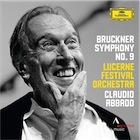
Karajan and Abbado recordings of Bruckner 9


Anton Bruckner, Symphony No. 9

Vienna Philharmonic
Herbert von Karajan
May 27 1962
Archipel Desert Island Collection  (ARPCD 0546)
(This disc also includes Bruckner’s Te Deum, from the same concert)

Lucerne Festival Orchestra
Claudio Abbado
August 21-26 2013
Deutsche Grammophon 4793441


Separated by just over 50 years, this pair of live recordings of Bruckner’s last symphony present a number of interesting contrasts. Herbert von Karajan’s performance from May 27 1962 is the first of his 12 recordings of the symphony. Claudio Abbado’s performance, recorded over a span of 5 days in August 2013, was his final ever recording before his sad death in January of this year. So we have two great Brucknerians, one at the very end of his career and the other at the beginning (at least of his recorded legacy). 
  
It would be hard to imagine two more different approaches. The timings tell the tale. Both conductors use the 1951 Nowak edition. Karajan comes in at a very brisk 53’45”. Abbado is much more expansive at 62’30”. Scanning John Berky’s Bruckner discography turns up very few recordings quicker than von Karajan (one of them being a justly celebrated Barbirolli live performance from 1966 with the Hallé Orchestra). Abbado’s timing is more mainstream.

Von Karajan attacks the first movement with great urgency and maintains momentum throughout. It is a very exciting performance, but not one that fully observes the Feierlich misterioso guidance – there is not much solemnity in the movement and the mystery really only comes in the coda. The second movement is much more in line with Bruckner’s concept, bringing out the menacing rhythms of the scherzo and trio. The third movement adagio is where it really all comes together. Karajan allows the lyrical dimensions of the movement to emerge in ways that he didn’t in the first movement. Here it really is Feierlich, building up to a very powerful climax and dissolving in the coda. 

A key to Abbado’s very contrasting interpretation comes in a remark from his assistant Gustavo Gimeno quoted in the booklet: “He conducted with broad, slow movements, with a long musical line, trying to create a form in which the musical discourse could develop. Slow, but flowing”. The great strength of Abbado’s conducting is his success in combining rhythmic urgency with expansiveness and an extraordinary clarity. There is a price to pay, though. The edge is taken off some of the more climactic and dissonant sections – certainly in the first movement and to a lesser extent in the scherzo. The Adagio is magnificent, however. The dissonant climax does not disappoint and the performance lives up to Simpson’s description of the movement – “though not his most perfect, it is his most profound”.

The sound quality is excellent on the Abbado and more than acceptable on the von Karajan recording (which, unfortunately, has no liner notes or recording details). For Bruckner enthusiasts the choice is easy. You need both!

Monday, August 11, 2014

Zemlinksy's First and Second Quartets (Escher Quartet)


Zemlinsky: String Quartets Vol 2 / Escher Quartet

Zemlinsky, Alexander
String Quartets Vol. 2

String Quartet No. 1 in A major (Op. 4)
String Quartet No. 2 (Op. 15)

The Escher Quartet

Naxos CD (8.573088)


This is the second CD in the Escher String Quartet’s rendition of Alexander Zemlinsky’s four string quartets. Confusingly, Volume 2 contains the first two quartets, while Volume 1 contains the third and fourth. In any event, this disc is a very worthy successor to the well-regarded first CD in the mini-cycle. The Escher Quartet is clearly very comfortable in all of Zemlinsky’s multiple voices and advocates powerfully for the chamber music of this unjustly neglected master of the string quartet.

Alexander Zemlinsky was truly a transitional figure, living from 1871 to 1942. He was born the year after Wagner moved to Bayreuth and died in the middle of the Second World War, the year that his brother-in-law Arnold Schoenberg wrote his piano concerto.  His string quartets are spread out throughout his composing career. The first was written in 1896. The others followed in 1913, 1924 and 1936. Each is stylistically different. The first clearly shows the influence of Brahms. The language of the second is closer to the Schoenberg of Verklärte Nacht. In the third quartet Zemlinsky is much more formal and restrained, while the fourth is a lament for Alban Berg and inhabits a similar musical universe.

But Zemlinsky did not simply soak up the musical landscape surrounding him. Within each of these musical personae he developed a distinctive voice, as is very clear in the two quartets recorded here. The four movement structure of the first quartet is fairly traditional and the voice of Brahms is clearly present, but the Allegretto is very much Zemlinsky’s own with a portfolio of Austro-Hungarian tunes, including a furiant dance from Bohemia that Brahms could never have written. The slow movement is very expressive and intense. The quartet as a whole is pushing at the limits of tonality, but clearly has a home key.

Seventeen years later, the second quartet is very different. It is certainly not atonal but Zemlinsky does not give it a key signature. The structure is unusual – a single extended movement made up of 5 distinct episodes. This is Zemlinsky’s weightiest quartet (and also by some way the longest, at a shade under 43 minutes).  It is deeply melancholy and expressive, with a particularly memorable Adagio (episode 2) complemented by the final episode (Langsam). This is a quartet of the first rank and badly deserves to be better known.

Naxos is to be congratulated for putting out this disc and for championing the music of Alexander Zemlinsky, whose quartets will hopefully reach a wider audience. Recommended.  


Friday, August 8, 2014

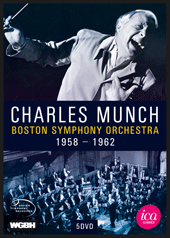
Charles Munch conducting the Boston Symphony Orchestra 1958-1962 (Boxed DVD set)


CHARLES MUNCH AND THE BOSTON SYMPHONY ORCHESTRA (1958-1962) (5 DVD Box Set) (NTSC)Boston Symphony Orchestra: 1958 - 1962

Charles Munch, conductor

ICA Classics ICAB 5130 (5 DVDs)


The Boston Symphony Orchestra was a television pioneer. More than 150 live concerts were broadcast by the Boston TV station WGBH between 1955 and 1979. ICA has taken on the task of making many of these performances available on DVD. This box collects a series of performances with Charles Munch at the podium, all recorded at Harvard University’s Sanders Theater. The sound quality is variable and not all of the performances are equally satisfying, but the best performances here are truly memorable and the collection as a whole is an important historical document.


Charles Munch, who was himself French, is probably best known today for his recordings of the French orchestral tradition, with a particular affinity for Debussy, Ravel, Berlioz, and Saint-Saens. But on this disc we have something completely different, with a range of composers who do not typically come to mind when one thinks of Munch. The collection features a Haydn symphony (No. 98), two Mozart symphonies (No. 36, the Linz, and No. 38, the Prague), two Beethoven symphonies (Nos. 4 and 5), Schubert’s No. 5, and Schumann’s No. 2, in addition (stunningly) to Bruckner 7 and Mendelssohn 4 and 5 (the Scottish and the Italian).


Brisk conducting is a common thread through all of these performances. Bruckner’s Seventh is dispatched in a little over 50 minutes, for example. For comparison, relatively few performances come in at over 60 minutes. At its best this can be exhilarating. Munch’s tempi are very successful in Schumann’s Second, where Munch and the BSO deliver a blistering performance of the first movement and a rousing finale. The Allegro vivace first movement in Beethoven’s Fourth is vivace indeed and the searching and well-paced finale in that symphony is an excellent bridge to the scherzo and finale, which are taken at a racing pace. The two Mendelssohn symphonies lend themselves to Munch’s pace.


But at times Munch’s addiction to speed is his undoing. The Bruckner 7 performance is really rather disappointing (although the orchestra and audience seemed pleased enough). It would have been interesting to hear how a conductor as rhythmically precise and sensitive to details of orchestral color as Munch is could perhaps shed new light on the symphony. But there’s little time in the sprint to stop and smell the roses.


To my ear the finest performances here include Haydn No. 98 , which Munch takes in a more Romantic vein than we would now be used to – an approach that pays dividends in the luscious string sound in the Adagio. Munch is ideally suited to the playful finale. The two Beethoven symphonies are also very successful, particularly the Fifth where Munch’s driving momentum is strengthened not undermined by flexible tempi. The performance of Schumann’s Second is very memorable.


Anyone interested in the history of conducting should think seriously about this set. It documents a powerful and exciting performer in a relatively unfamiliar repertoire (as far as Munch recordings are concerned). There are highs and lows, but from a purely musical point of view some of the performances are stand-outs. I would certainly encourage buying the set, but all of the DVDs are available separately and if funds are limited then I would recommend DVD 1 (the two Beethoven symphonies ), followed by DVD 4 (Schubert 5 and Schumann 2).